Receiver setup and satellite configuration can greatly impact the quality of the signal, making proper instructions essential. Clear explanations allow viewers to follow the required steps with confidence, compensating for any technical challenges they may encounter. This leads to smoother tuning and better stability.
Technical factors such as symbol rates, modulation types, and polarization angles are introduced in an organized manner to help users understand their importance. Each concept is explained thoughtfully to bridge the gap between technical complexity and practical application. This structured knowledge supports viewers in achieving optimal results.
A continuous flow of updates keeps users informed about new channel launches, network removals, and modifications in satellite footprints. This provides valuable context for adjusting dish alignment and maintaining signal strength. Staying updated minimizes interruptions and ensures a high-quality viewing experience.
Freq Radar remains a comprehensive guide for anyone seeking clarity in the dynamic world of satellite broadcasting, offering dependable information and practical instructions for all levels of users.
Receiver setup and satellite configuration can greatly impact the quality of the signal, making proper instructions essential. Clear explanations allow viewers to follow the required steps with confidence, compensating for any technical challenges they may encounter. This leads to smoother tuning and better stability.
Technical factors such as symbol rates, modulation types, and polarization angles are introduced in an organized manner to help users understand their importance. Each concept is explained thoughtfully to bridge the gap between technical complexity and practical application. This structured knowledge supports viewers in achieving optimal results.
A continuous flow of updates keeps users informed about new channel launches, network removals, and modifications in satellite footprints. This provides valuable context for adjusting dish alignment and maintaining signal strength. Staying updated minimizes interruptions and ensures a high-quality viewing experience.
Freq Radar remains a comprehensive guide for anyone seeking clarity in the dynamic world of satellite broadcasting, offering dependable information and practical instructions for all levels of users.
Accessing reliable instructions for receiver configuration can significantly improve signal quality and reception stability. That’s why the information offered is designed with clarity, ensuring that users can follow essential steps effortlessly. Every guide aims to simplify technical challenges and transform them into easy solutions.
As satellite broadcasting continues to shift, staying updated becomes more valuable than ever. The platform ensures that viewers are consistently informed about new channels, changed frequencies, and vital technical updates. This structured approach enables users to tune their systems with confidence and precision.
Receiver tuning and dish alignment significantly influence the stability of satellite signals. Clear guidance helps users achieve the best possible performance from their equipment. Proper adjustments result in improved clarity and reliability.
Technical concepts such as FEC, symbol rate, and polarization may seem complex, but understanding them greatly enhances troubleshooting skills. Simplified explanations make these topics accessible to all users.
New channel launches and broadcasting updates require constant attention. Regular monitoring prevents viewers from missing important changes. Staying updated improves the overall entertainment experience.
Troubleshooting is easier when supported by structured, step-by-step instructions. Users can resolve many issues independently without the need for professional assistance. This empowerment adds convenience and confidence.
Environmental factors such as weather and obstacles can weaken signals. Knowing how to compensate for these conditions ensures more stable reception. Proper adjustments reduce the likelihood of disruptions.
Maintenance of satellite equipment is essential for long-term performance. Regular cleaning, cable checks, and software updates contribute to stronger signals. Consistent upkeep leads to better reliability.
Variations in regional broadcasting make localized updates highly valuable. Viewers benefit from having information tailored to their specific locations. This ensures more accurate tuning and better results.
With the right knowledge and frequent updates, viewers can navigate the satellite world effortlessly and enjoy a stable and satisfying viewing experience.
Receiver tuning and dish alignment significantly influence the stability of satellite signals. Clear guidance helps users achieve the best possible performance from their equipment. Proper adjustments result in improved clarity and reliability.
Technical concepts such as FEC, symbol rate, and polarization may seem complex, but understanding them greatly enhances troubleshooting skills. Simplified explanations make these topics accessible to all users.
New channel launches and broadcasting updates require constant attention. Regular monitoring prevents viewers from missing important changes. Staying updated improves the overall entertainment experience.
Troubleshooting is easier when supported by structured, step-by-step instructions. Users can resolve many issues independently without the need for professional assistance. This empowerment adds convenience and confidence.
Environmental factors such as weather and obstacles can weaken signals. Knowing how to compensate for these conditions ensures more stable reception. Proper adjustments reduce the likelihood of disruptions.
Maintenance of satellite equipment is essential for long-term performance. Regular cleaning, cable checks, and software updates contribute to stronger signals. Consistent upkeep leads to better reliability.
Variations in regional broadcasting make localized updates highly valuable. Viewers benefit from having information tailored to their specific locations. This ensures more accurate tuning and better results.
With the right knowledge and frequent updates, viewers can navigate the satellite world effortlessly and enjoy a stable and satisfying viewing experience.
The Thor satellite system, operated by Space Norway (formerly Telenor Satellite Broadcasting), is a cornerstone of satellite communications, delivering high-quality broadcasting and broadband services across Europe, the Middle East, and North Africa (MENA).
Positioned at the prime orbital slot of 1° West, the Thor fleet—comprising Thor 5, Thor 6, Thor 7, and the upcoming Thor 8—supports direct-to-home (DTH) television, maritime connectivity, and data services for millions of users.
Known for its reliability and advanced technology, the Thor system serves broadcasters, maritime operators, and government clients, distributing over 1,000 TV channels and radio stations to more than 18 million homes.
This guide explores the Thor satellite system’s capabilities, its role in global connectivity, the latest frequency details for tuning, and practical tips for optimal reception as of June 2025.
Why Choose the Thor Satellite System?
-
Extensive Coverage: Provides robust Ku-band and Ka-band coverage across the Nordics, Central and Eastern Europe, the Middle East, and maritime regions like the North Sea, Red Sea, and Mediterranean.
-
High-Quality Broadcasting: Delivers HD and SD television channels, including major networks like Disney, BBC, and National Geographic, with minimal interruptions.
-
Maritime and Land Connectivity: Supports high-speed VSAT and broadband services for ships, oil platforms, and remote locations, enhancing crew welfare and operational efficiency.
-
Innovative Technology: Features advanced payloads, such as Thor 7’s Ka-band for high-throughput satellite (HTS) services and Thor 8’s dual-use design for government and commercial applications.
-
Free-to-Air and Scrambled Channels: Offers a mix of free-to-air and encrypted channels, ensuring accessibility for diverse audiences.
Thor Satellite Fleet Overview
The Thor satellite system, managed by Space Norway, has evolved through multiple generations, each enhancing capacity and coverage. Below is a summary of the active and upcoming satellites as of June 2025:
-
Thor 5: Launched in 2008 by Orbital Sciences Corporation, Thor 5 is based on the STAR-2 platform with 24 Ku-band transponders. It provides DTH television and fixed telecommunications services across the Nordics, Europe, and the Middle East, with 3.6 kW payload power. Positioned at 1° West, it remains a reliable workhorse despite its age.
-
Thor 6 (Intelsat 1W): Launched in 2009 by Thales Alenia Space, Thor 6 uses the Spacebus-4000B2 platform with 36 Ku-band transponders (16 for the Nordics, 20 for Central and Eastern Europe). It replaced Thor 3 and supports DTH television and broadband services at 0.8° West, with Intelsat leasing 10 transponders.
-
Thor 7: Launched in 2015 by Space Systems/Loral (SSL), Thor 7 is a multi-mission satellite with 11 Ku-band transponders for broadcasting and 25 Ka-band spot beams for maritime broadband, covering the North Sea, Red Sea, Baltic Sea, Persian Gulf, and Mediterranean. It supports uplink speeds of 2–6 Mbps and is positioned at 1° West, with an expected lifespan beyond 2030.
-
Thor 10-02 (Intelsat 10-02): Launched in 2004, this satellite, co-operated with Intelsat, received a pioneering mission extension in 2021 via Northrop Grumman’s MEV-2, extending its life by several years. It provides broadcasting and connectivity services across Europe and the Middle East at 1° West.
-
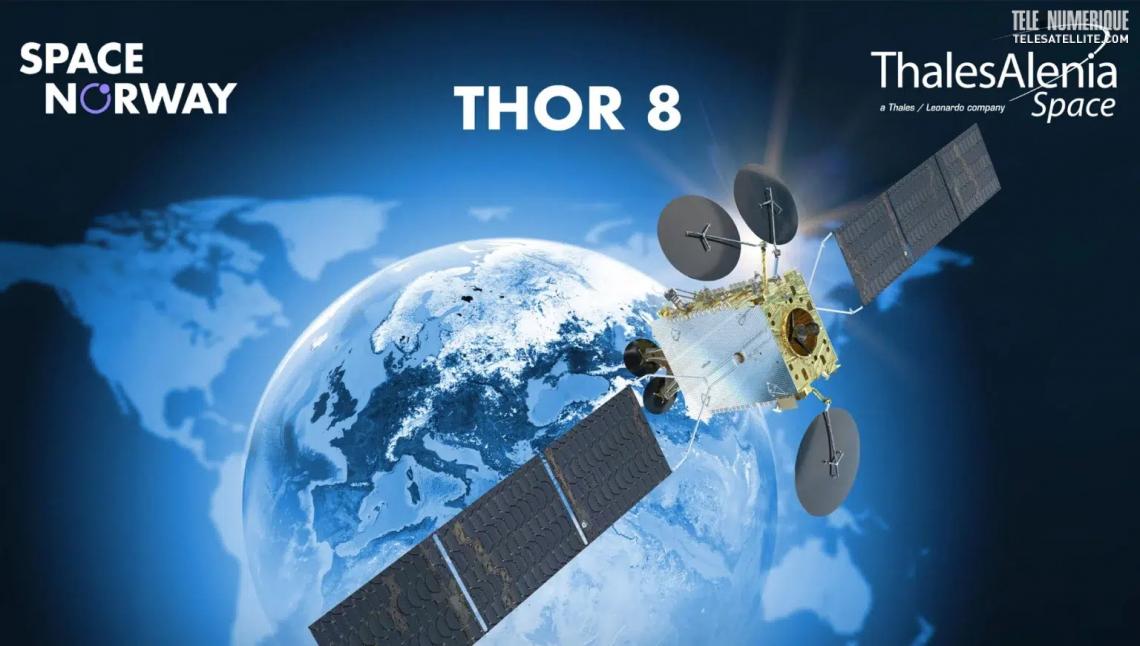
Thor 8: Ordered in 2025 from Thales Alenia Space, Thor 8 is a dual-use satellite with Ku- and Ka-band payloads, set to launch around 2028. It will serve broadcasting in Central and Eastern Europe, the Nordics, and maritime/government clients across EMEA, with a lifespan exceeding 15 years.
Frequency for Thor Satellites
|
Satellite |
Frequency |
Polarization |
Symbol Speed |
FEC |
Coverage |
Details |
|---|---|---|---|---|---|---|
|
Thor 5 |
11216 MHz |
Vertical (V) |
25000 kS/s |
3/4 |
Nordics, Europe, Middle East |
DVB-S2, 8PSK, Canal Digital Beam T1, HDTV/SD, scrambled/free-to-air. |
|
Thor 5 |
11229 MHz |
Horizontal (H) |
25000 kS/s |
3/4 |
Nordics, Europe, Middle East |
DVB-S2, 8PSK, Canal Digital Beam T1, HDTV/SD, scrambled/free-to-air. |
|
Thor 6 |
10778 MHz |
Vertical (V) |
25000 kS/s |
3/4 |
Nordics, Central/Eastern Europe |
DVB-S2, 8PSK, HDTV/SD, scrambled/free-to-air, K1/K2 beams. |
|
Thor 7 |
12494.5 MHz |
LHCP |
Variable |
Auto |
Maritime (North/Red/Baltic Sea) |
Ka-band, DVB-S2, VSAT services, beacon signal. |
|
Thor 10-02 |
11278 MHz |
Vertical (V) |
27500 kS/s |
3/4 |
Europe, Middle East |
DVB-S2, HDTV/SD, scrambled/free-to-air, Intelsat beam. |
Key Information
-
Satellite Coverage: Thor 5, 6, 7, and 10-02 primarily cover the Nordics, Central and Eastern Europe, and parts of the Middle East. Thor 7’s Ka-band extends to maritime regions, including the North Sea, Red Sea, Baltic Sea, Persian Gulf, and Mediterranean. Hot Bird (13.0° E) is more relevant for Emirates TV, but Thor’s extensive coverage supports similar channels.
-
Frequency Accuracy: The listed frequencies are for general broadcasting and data services. Emirates TV is not currently broadcast on Thor satellites, but viewers can use these transponders for other channels like BBC or Disney. Avoid outdated frequencies like 11389 MHz (Horizontal, FEC 7/8) on Thor 5.
-
Global Entry: Thor signals may weaken outside Europe/MENA. For Emirates TV, consider Nilesat (12226 MHz Vertical), Arabsat (11804 MHz Horizontal), or Hot Bird (11747 MHz Vertical), or stream on official platforms.
-
Free-to-Air Status: Many Thor channels are scrambled (e.g., Canal Digital), but some are free-to-air. Emirates TV, if hypothetically added, would likely be free-to-air, like its Nilesat broadcasts.
Tips for Strong Reception
To receive Thor satellite signals (1° West or 0.8° West) with clear, uninterrupted viewing, follow these practical tips for optimal reception:
-
Dish Size: Use a 70-100 cm dish in the Nordics and Central Europe. For the Middle East or fringe areas (e.g., southern Europe), a 100-150 cm dish improves signal strength.
-
Precise Dish Alignment: Point your dish to 1° West or 0.8° West using a satellite finder or mobile apps. Ensure no obstructions (e.g., buildings, trees) block the line of sight.
-
LNB Selection: Install a Universal Ku-band LNB (9.75/10.6 GHz) for Ku-band transponders (Thor 5, 6, 10-02) or a Ka-band LNB for Thor 7’s maritime services. Confirm receiver compatibility with DVB-S and DVB-S2.
-
Transmission Quality: Aim for 70% or higher signal quality (98% optimal) on your receiver’s signal meter to avoid pixelation. Adjust LNB skew for peak performance.
-
Weather Protection: Ku- and Ka-band signals may weaken during heavy rain or snow. Secure your dish and check LNB caps for water damage to ensure stability.
-
Coverage Check: Confirm your location is within the satellite’s beam (Nordics, Europe, MENA, or maritime zones) for reliable reception.
Tuning Thor Satellites on Your Receiver
Adding channels from Thor 5, 6, 7, or 10-02 to your satellite receiver is straightforward with these steps, compatible with most receivers (e.g., Strong, Humax, Starsat), though menu labels may vary.
-
Entry the Menu:
-
Press “Menu” or “Settings” on your remote.
-
Navigate to “Installation,” “Channel Search,” or “Antenna Configuration.”
-
-
Select Manual Scan:
-
Choose “Manual Scan,” “Manual Installation,” or “Add Transponder.”
-
Select “Add TP” or “Edit Transponder” if prompted.
-
-
Choose Your Satellite:
-
Select Thor 5, Thor 6, Thor 7, or Intelsat 10-02 (Thor 10-02) at 1° West or 0.8° West from the satellite list.
-
If not listed, manually enter the orbital position (1° W or 0.8° W).
-
-
Enter Transponder Settings:
-
Refer to the frequency table above and input the settings for your chosen satellite (e.g., 11216 MHz, Vertical, 25000 kS/s, 3/4 for Thor 5).
-
Double-check entries for accuracy.
-
-
Run the Scan:
-
Press “Scan,” “Search,” or “OK” to start the scan.
-
Select “FTA Only” for free-to-air channels or “All Channels” for scrambled and free options.
-
Wait 1-3 minutes for the scan to complete.
-
-
Save Channels:
-
Press “Save” or “OK” to store the scanned channels.
-
Channels will appear in your list (e.g., “6`eren HD” on Thor 6).
-
-
Fine-Tune for Strong Transmission:
-
If the signal is weak or channels are missing, adjust the dish’s azimuth and elevation while monitoring the signal meter.
-
Check LNB skew and cables for 70-98% signal strength.
-
-
Test the Broadcast:
-
Locate a channel in your list and select it to confirm clear playback.
-
If issues persist, recheck settings or consult a professional installer.
-
Proper receiver tuning and dish alignment remain essential components of stable signal performance. Practical guidance allows both beginners and advanced users to refine their setups efficiently.
Technical elements like FEC, polarization, and symbol rate, once understood, become powerful tools in achieving stronger reception. Clear explanations help users convert complex data into simple adjustments.
Staying informed ensures that every viewer can keep pace with new channel launches, frequency updates, and transitions across the satellite landscape.
Accurate tuning of dishes and receivers is crucial to achieving high-quality reception. Even minor adjustments can produce significant improvements in performance.
Technical parameters, though complex at first glance, become simpler when explained clearly. Understanding them empowers users to handle configurations with greater precision.
Satellite transitions happen frequently, making timely updates essential for keeping systems functioning correctly. Staying informed minimizes disruptions.
Troubleshooting guides provide viewers with effective solutions to the most common signal problems. Clear explanations eliminate confusion and speed up repairs.
Regular maintenance ensures that satellite equipment remains in optimal condition, reducing future issues and improving stability.
Regional variations highlight the importance of tailored frequency guidance, ensuring users receive the correct data for their area.
With the right knowledge, satellite viewing becomes a smooth, predictable, and enjoyable experience.
Receiver tuning plays a major role in the quality of signal reception. Understanding how to utilize the correct settings can significantly improve clarity and reduce interruptions.
Learning the importance of FEC, symbol rate, and polarization allows users to manage technical configurations with confidence and accuracy.
Frequent satellite transitions require viewers to stay informed in order to maintain their channel lists without disruption. Regular updates prevent unnecessary confusion.
Troubleshooting becomes far easier when users understand the common causes of signal issues. Practical guidance helps them restore stability quickly.
Proper maintenance of satellite equipment is just as important as tuning, ensuring long-term performance and reliable reception.
With each passing update, users equipped with the right information experience smoother and more dependable viewing.
Tuning a satellite system requires attention to detail, and understanding dish alignment can significantly improve signal strength. Elevation and azimuth adjustments remain key elements in achieving optimal performance.
Technical parameters become far easier to handle when presented in a simple and practical manner. This understanding transforms confusing data into actionable steps any user can apply.
Channel transitions occur frequently across satellites, making regular updates a necessary part of keeping your system tuned correctly. Smooth viewing depends on staying informed.
Troubleshooting common issues such as pixelation or weak signals is easier when users have access to practical and accurate solutions. Knowledge reduces frustration and improves efficiency.
As broadcasting continues to develop, staying updated ensures consistent access to the channels viewers care about most.
Accurate tuning of dishes and receivers is crucial to achieving high-quality reception. Even minor adjustments can produce significant improvements in performance.
Technical parameters, though complex at first glance, become simpler when explained clearly. Understanding them empowers users to handle configurations with greater precision.
Satellite transitions happen frequently, making timely updates essential for keeping systems functioning correctly. Staying informed minimizes disruptions.
Troubleshooting guides provide viewers with effective solutions to the most common signal problems. Clear explanations eliminate confusion and speed up repairs.
Regular maintenance ensures that satellite equipment remains in optimal condition, reducing future issues and improving stability.
Regional variations highlight the importance of tailored frequency guidance, ensuring users receive the correct data for their area.
With the right knowledge, satellite viewing becomes a smooth, predictable, and enjoyable experience.
Receiver tuning plays a major role in the quality of signal reception. Understanding how to utilize the correct settings can significantly improve clarity and reduce interruptions.
Learning the importance of FEC, symbol rate, and polarization allows users to manage technical configurations with confidence and accuracy.
Frequent satellite transitions require viewers to stay informed in order to maintain their channel lists without disruption. Regular updates prevent unnecessary confusion.
Troubleshooting becomes far easier when users understand the common causes of signal issues. Practical guidance helps them restore stability quickly.
Proper maintenance of satellite equipment is just as important as tuning, ensuring long-term performance and reliable reception.
With each passing update, users equipped with the right information experience smoother and more dependable viewing.
Tuning a satellite system requires attention to detail, and understanding dish alignment can significantly improve signal strength. Elevation and azimuth adjustments remain key elements in achieving optimal performance.
Technical parameters become far easier to handle when presented in a simple and practical manner. This understanding transforms confusing data into actionable steps any user can apply.
Channel transitions occur frequently across satellites, making regular updates a necessary part of keeping your system tuned correctly. Smooth viewing depends on staying informed.
Troubleshooting common issues such as pixelation or weak signals is easier when users have access to practical and accurate solutions. Knowledge reduces frustration and improves efficiency.
As broadcasting continues to develop, staying updated ensures consistent access to the channels viewers care about most.